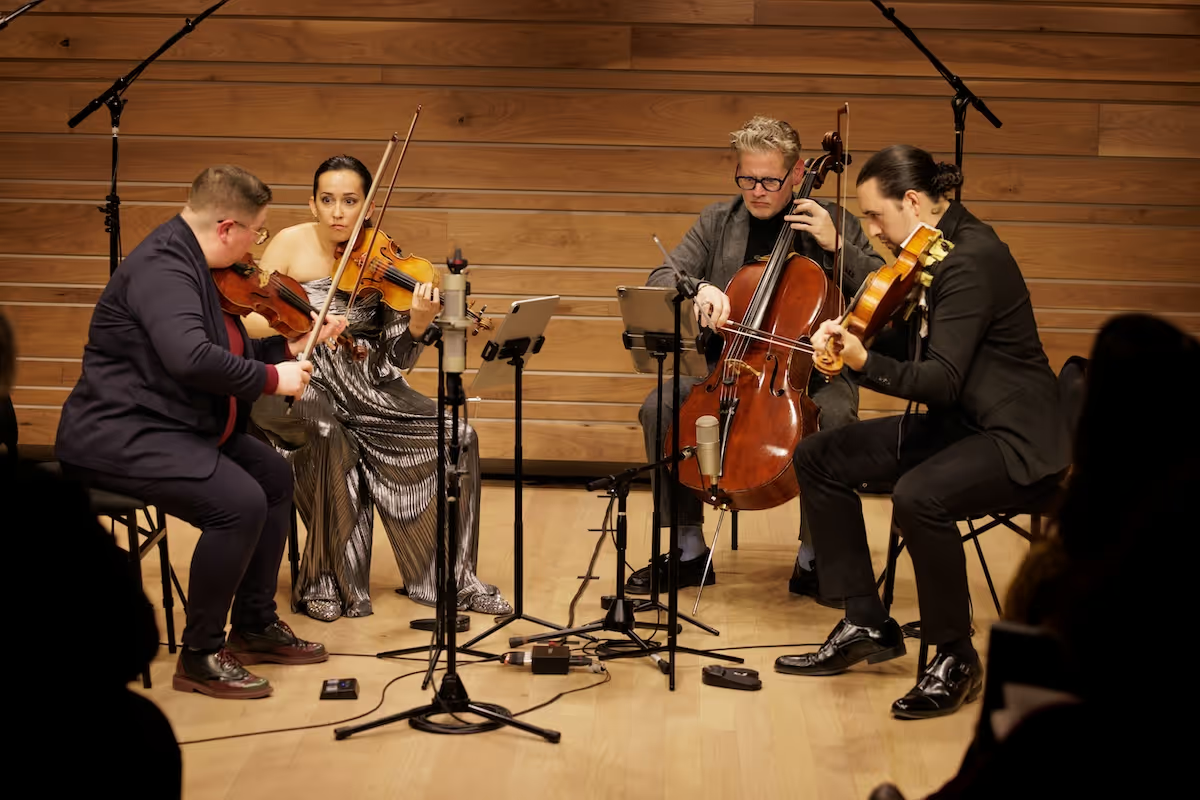
One of my favorite things about reviewing music, arts, and culture in Chicago is being in the audience to experience artists in their habitat. That could be a big stage like the Goodman or a former neighborhood movie theater turned into an event space. Then there is the intimate space of Guarneri Hall, where Nova Linea Musica (NLM) concerts are held. On December 3, NLM presented the Catalyst Quartet in a program titled Against All Odds.
Nova Linea Musica was created as an incubator for new music and a space for artists-in-residence and development here in Chicago. NLM is unique in offering a casual talk with the musicians and composers before the concert. I have been to many venues where an expert panel or scholar gives a lecture on what is being presented. It's not a vibe that enriches the performance, in my opinion. Host Doyle Armbrust offers a welcoming atmosphere that gives performers and the audience insight into the concert.
The Against All Odds preconcert discussion featured composer Andrea Casarrubios discussing the world premiere of Unsaying. Violist Paul Laraia and cellist Karlos Rodriguez each spoke about the playing process and their approach to the music. The composer Derek Skye joined the discussion via satellite. I must note that Skye had the ocean and swaying palm trees as his backdrop, while Chicago had received our first significant snowfall and a temperature drop. Skye has a wonderful sense of humor and said, "I like to mess with people's heads."

It was a special night, with several composers on hand to hear their music performed by the Catalyst Quartet. Jorge Enrique Amado Molina briefly commented on Tríptico Cubano and what a great experience he had with CQ. One of my favorite composers, Jessie Montgomery, was present as an alumnus of the Catalyst Quartet, and her 2016 composition, Build, was on the program. At my first NLM concert, the Dover Quartet played Montgomery's Strum. NLM's 2025-26 Composer in Residence, Dr. Stacy Garrop, was also on hand. Her compositions were commissioned for Letters From Home, the March 2025 concert.
The Catalyst Quartet was founded in 2010 by the Sphinx Organization of Detroit, Michigan. The members are violinists Abi Fayette and Karla Donehew Perez, violist Paul Laraia, and cellist Karlos Rodriguez. Each of these extraordinary musicians evokes the power of their instrument as an extension of themselves, their experiences, and emotions. I call it the music-soul connection, and I have seen it more frequently with new musical compositions and those who play them. The rapport between them is palpable. I could hear them taking breaths, reminding me of the Latin term for inspiration - inspirare. They were taking breaths that flowed into some virtuosic playing. It enhanced the playing, giving the music a visceral substance. This was music to be felt in the skin.
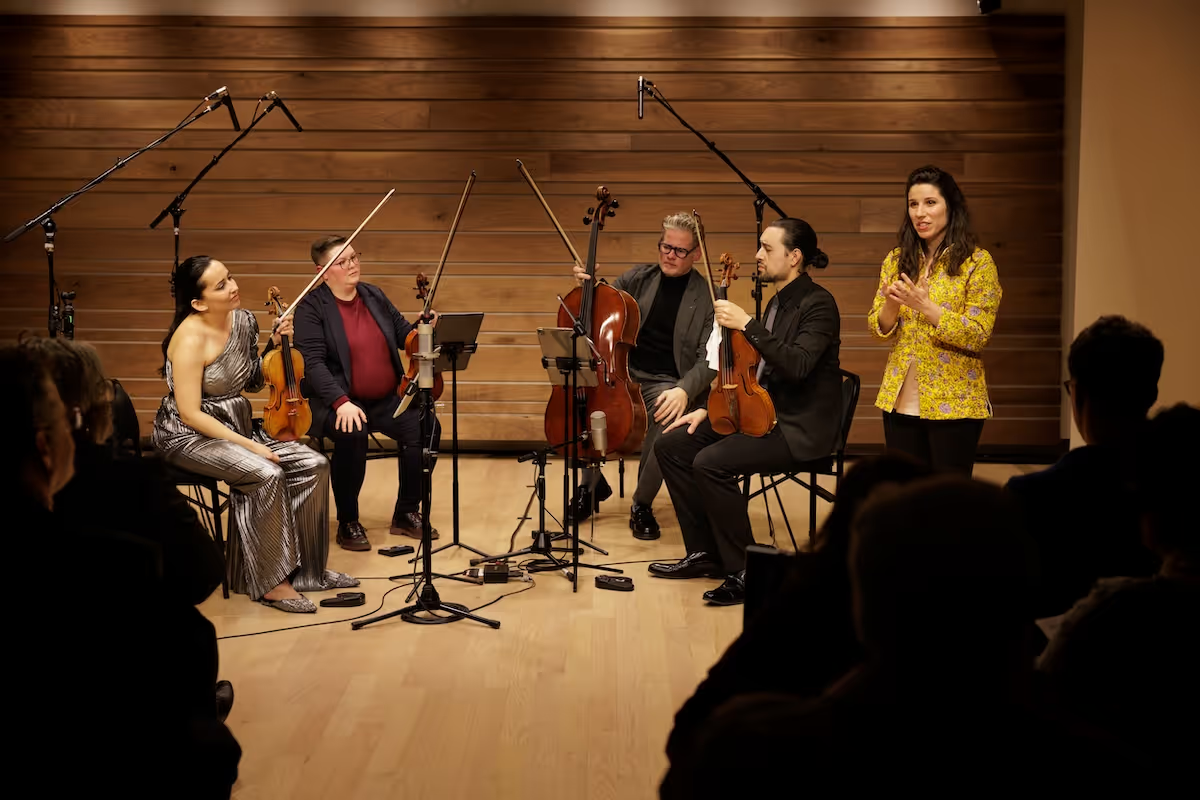
The concert opened with a composition from John Adams. He is considered one of the most influential American composers. Fellow Traveler was written as a birthday gift for his friend and collaborator Peter Sellars. Adams and Sellars collaborated on two contemporary operas—Nixon in China and Doctor Atomic. Fellow Traveler is about J. Robert Oppenheimer, Joseph McCarthy's fearmongering, and the House Un-American Activities Committee (HUAC). The driving tempo of martelé and staccato playing created a picture in my mind. I imagined a train barreling through the subway tunnels and eventually driving into the terminal. The music is gripping, and while reminiscent of the Red Scare era, it has an eerie symmetry with the current American political environment. Fellow Traveler gave me chills of recognition.
The following two compositions were played together, with a brief pause between them. Madre de los promores is a vocal piece written in 1686 by Sor Juana Inés de la Cruz. She was a Hieronymite nun and a self-taught polymath who defied all odds in colonial Mexico. The Catalyst Quartet arranged "Madre de los promores" into a meditative instrumental. It was paired with Aftab Darvishi's Daughters of Sol, inspired by a poem by a fellow Iranian, Ahmad Shamlou. Darvish's composition flows beautifully into a gently swirling, prayerlike paean to emotions and spirit. Both composers lock into the theme of Against All Odds. Darvishi wrote a composition for Kronos Quartet protesting the restriction on immigration to America. She is another woman born into an oppressive culture who voiced her creativity and protest against an oppressive culture here, in America.
Jorge Enrique Amado Molina is a Cuban musician making a global impact. His Tríptico Cubano (Cuban Tryptych) has three movements that illustrate growing up in an environment that pits a person against the odds of success. Each movement is a play on the Cuban climate. Monte means jungle, Culebras means snakes, and Sol means sun. I consider myself fortunate to be able to complain (brag) about Chicago's harsh winters. The music is bright and lively, creating a soundscape that evokes a life filled with daily challenges, but they are overcome by leaning into tradition and a sense of pride in your homeland.
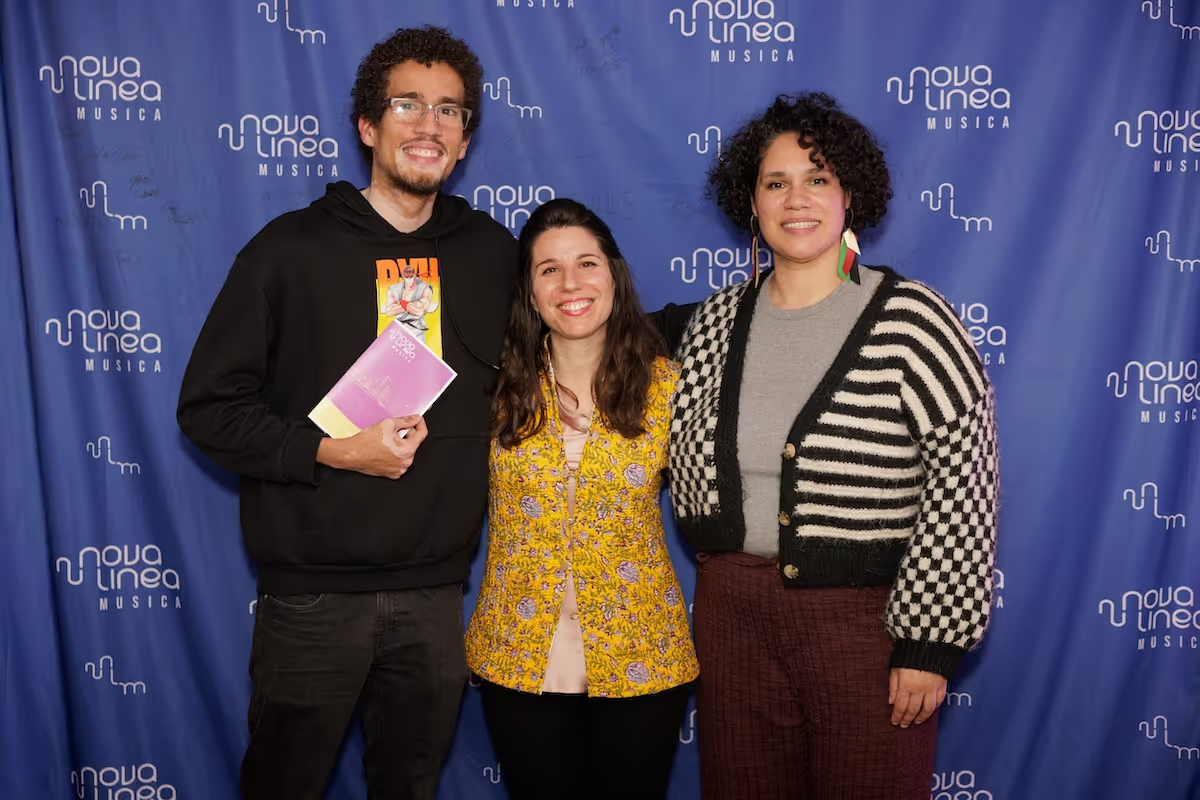
Andrea Casarrubios's Unsaying was the first of the two world premieres on the program. In the pre-concert discussion, she spoke of building tension in the music's rests. The tension also builds in the longer notes, giving some of the phrases a feeling of a long shadow of sound. For me, music forms a mental picture. There was a gentle expressionistic vibe to Unsaying—anticipation and then the gentle release of silence at the end. It was a short piece, and yet it filled the aural space, leaving a deep impression.
The world premiere of Derrick Skye's Flare and Answer followed, and it was a wild ride. Skye uses the maqam scale, blues chords, and the Western melodic scale to evoke the shores of West Africa, the riads of North Africa, and ancient Persia. Flare and Answer required audience participation of clapping on our thighs in a 4/4 tempo. Violinist Abi Fayette introduced the piece and tapped her feet to set the tempo as she played. Actually, tapping feet does not honestly describe how she led the rhythm. Fayette lifted her knee high and bounced as if dancing. I loved how all of the Quartet members seemed to almost levitate out of their seats. Flare and Answer also had a Gaelic sound that would have sent any pub in Ireland into a dance frenzy. Speaking of anticipation and joyful tension, I expected Fayette to kick the chair back to stand and play.
Jessie Montgomery's Build followed with lively pizzicato and mixed tempo bowing. Build also evoked graceful physical movements and vast land vistas. The bluesy passages and the low cello hum have a distinctly urban feel that turns into a wondrous carousel of buildings forming valleys and then people in motion. " Build" is a perfect title for the music because it builds tension, as if there is a race against time to reach something extraordinary. The climax of the piece swirls with a rootsy blend of blues, folk, and bluegrass. Montgomery is building a unique musical legacy that encompasses and elevates the American soundscape.
Fayette also introduced the final piece of the night by Coleridge-Taylor Perkinson. Fayette explained that we have probably heard his music and did not know it. Perkinson's career spanned television, film, and music for dance ensembles, particularly Alvin Ailey and the Dance Theater of Harlem. String Quartet No. 1, "Cavalry", was written in 1956. The three movements-Allegro, Adagio, and Allegro Vivace- reflect the music that was toppling the traditional American sound. Perkinson put jazz and blues passages throughout his music. There is, in the last movement, a passage that predates John Coltrane's Giant Steps by four years, in 1960. The Catalyst Quartet was in full swing for the entire concert, but the finale revealed their closeness as a group. They looked at each other as if having a spirited conversation; there was respect and flawless musicianship.
Music appreciation is an intimate and personal adventure for me. The Catalyst Quartet made that connection in my mind and body so that I could feel and hear music as an adventure. They have selected music from a group of composers who incorporate ancient, classical, and contemporary sounds. The music has the DNA of traditional classical, but it has evolved into something that can take the listener into new directions and ways of listening. I highly recommend you experience the Catalyst Quartet whenever you can.
The Catalyst Quartet performed for Nova Linea Musica on December 3 at Guarneri Hall, located at 11 E Adams St. For more information on NLM, click here. Some exciting concerts are coming up, including Third Coast Percussion at Merit School of Music in February, and NLM Artists in Residence at Guarneri Hall in March. You can find more information about the Catalyst Quartet at catalystquartet.com. NLM concerts are available on YouTube, but nothing beats being there in person.

