Meet the Performers
Pianist and composer Conrad Tao opened Nova Linea Musica's 2025-26 season in Chicago with the world premiere of Chris Mercer's Impromptu: Fluorescing. In this interview, originally conducted by Brian Mackey for The 21st Show on Illinois Public Media, Tao talks about performing with live electronics, human intuition versus machine intelligence, and what it means to return to Chicago.
Publish Date:
September 30, 2025
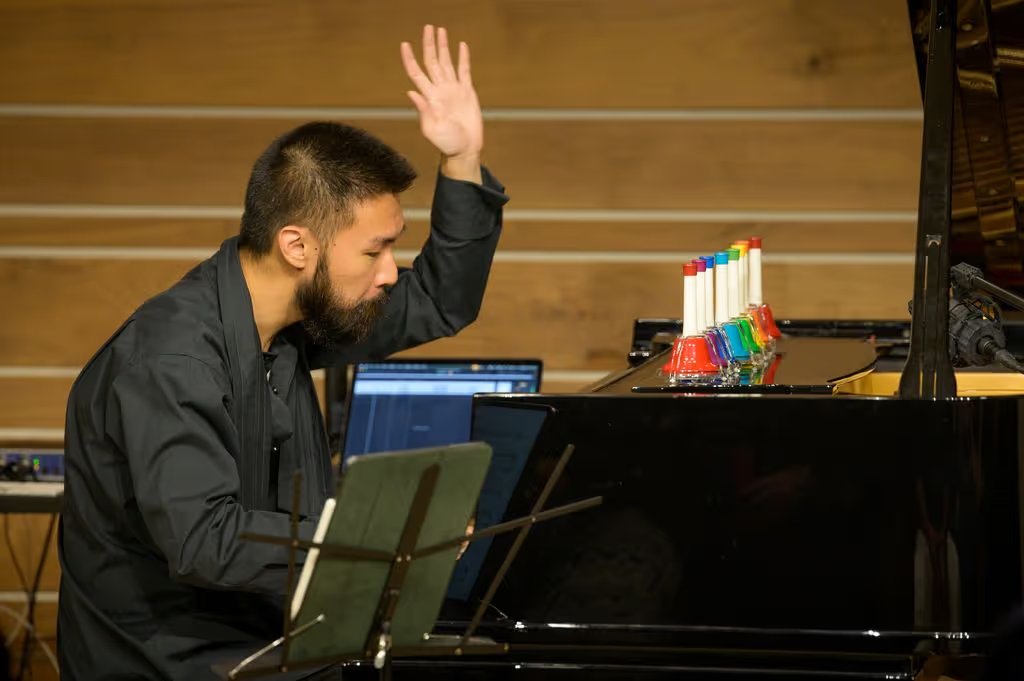
Conrad Tao on Listening, Algorithms, and Coming Home to Chicago
Originally conducted by Brian Mackey for The 21st Show, Illinois Public Media.
The pianist and composer opens Nova Linea Musica's new season with a program that puts human intuition and machine intelligence in conversation.
When Conrad Tao was growing up in Urbana, Illinois, he had a subscription to the Chicago Symphony Orchestra at age five. He studied here. He performed here. And then, like many prodigies before him, he eventually made his way to New York. This Wednesday evening, he returns to the city that shaped him, opening Nova Linea Musica's new season with a solo concert in downtown Chicago. The program, Echoes and Algorithms, features world premieres, works for piano and live electronics, and music that asks its performers — and its audiences — to let go of the need for a predetermined right answer.
We spoke with Tao about collaborating with computers, what it means to bring a piece like John Supko's 100,000 Billion Pieces to the concert stage, and why he believes the most important question you can ask about music isn't technical at all.
* * *
The concert is called Echoes and Algorithms. What does that phrase mean to you?
I didn't come up with the title myself, but it feels really apt. When I was putting this program together, I had a piece as a starting point: John Supko's 100,000 Billion Pieces for Piano and Computer. It's a piece that is sometimes hard to describe and hard to program, especially since I so often work in traditional concert hall settings. What John has given me is essentially a computer improviser — software that draws from an enormous bank of sounds. My part as a pianist is entirely improvised, and the work is completely modular: it can be as long or as short as one wants.
I've been fascinated for a long time by work where you're playing with electronics that respond actively to what you're doing. What I love is pieces where the electronics aren't simply receiving an audio signal and triggering something — where the signal flow isn't just one-directional, coming from me. I get very excited by things that are more of a two-way street. I wanted to create a program that orbited those ideas.
What do you actually know going into a performance? Do you know what the computer will do?
I actually know very little. What I do know is the general set of behaviors and sound worlds, because I've spent time with the work and explored different possibilities. The composition isn't a fixed sequence in time — the parameters are better described as relationships and possibility spaces. And importantly, John has deliberately designed the software so that I cannot move the piece forward entirely of my own volition. There are ways in which it can only progress when the computer allows it. That back and forth is exactly what I'm attracted to. There's something almost unsettling to me about having it be entirely up to me.
There's so much conversation right now about AI. Do you ever sense something like intelligence in what you're performing with?
It's always an instrument. I almost feel like the question of whether it's a true intelligence isn't the most interesting one. What I know is that the computer is making choices — it listens to me, and there are behaviors coded within it that it can choose between. From John's stated design philosophy, it's both mimicking what I'm doing and working against it. That has more to do with principles of group improvisation than it does with artificial intelligence. You can be in unison, you can be complementing one another, you can be in deliberate juxtaposition. I'm trying to intuit how the computer is relating to me at any given moment.
I'm pretty orthodox about this. Tools are tools. I think of it more as John's trace — what does he allow the software to do? And his vision is about indeterminacy, about what opens up when software is creating meaning. What meaning can emerge in that kind of mystery? That's the question.
You're premiering a new piece by Chris Mercer, commissioned by Nova Linea Musica. What can you tell us about it?
I discovered Chris via his work with live electronics, and when it came time to figure out what to do for this program, the idea of getting something from him was really exciting. He wrote me this piece called Impromptu Florescing — it's bubbly and happy, and I hope he wouldn't be offended by that characterization. It's a piece where the electronics are sometimes responding to me and other times behaving in ways that require me to listen before I make my own choices. Parts of it make me think of leveling up in an old video game, even though that's not the content of the work. It's a lovely, short, charming piece.
How do you think about the tension between tradition and innovation in classical music?
I lately almost don't think of it as pushing the form forward. I think of it more as having the form feel like an honest reflection of the context and the time it's in. The thing I feel most tension with in the classical music space is anxiety — not pushback, anxiety. An anxiety that if you don't signal that you know what the correct response is, you have nothing. Audience etiquette is an interesting example: I think a lot of people, first-timers and regulars alike, experience real anxiety about what they're supposed to be feeling.
I think about a moment from the premiere of a touring program I do with tap dancer Caleb Teicher. It debuted as a video in 2020, and they had us in the chat as it premiered. Early in the program there's an improvisation, and one audience member typed: 'I'm not sure I have the tools to evaluate this.' Another responded simply: 'Well, how does it make you feel?' with a smiley face. That little exchange encapsulated so much. The first response is the wrong question. The second is the right one.
You grew up in the Chicago area. What does it feel like to come back and perform here?
I am so happy to be from the Chicago area. I had a subscription to the CSO when I was five. I grew up going to Ravinia. And what was wonderful about the Chicago music scene was that you had such amazing musicians all around — but also a more intimate, small-town feeling. Chicago didn't carry the professional pressure that New York does automatically, and looking back I feel very fortunate about that. As I got older I grew to love the history of Chicago blues, house, footwork, all of the incredible dance culture here. There's also a really great new music community. I always feel warm inside when I get to play back at home.
* * *
Conrad Tao opened Nova Linea Musica's 2025-26 season in September with Echoes and Algorithms, a solo concert in downtown Chicago. The program included the world premiere of Chris Mercer's Impromptu Florescing, commissioned by NLM, alongside works by John Supko and Ben Nobuto, and Tao's own composition Hot Air.

