Concert Recap
Nova Linea Musica launched on October 23, 2024 with the Dover Quartet at Guarneri Hall. A recap of the sold-out concert that began a Chicago new music series.
Publish Date:
October 26, 2024
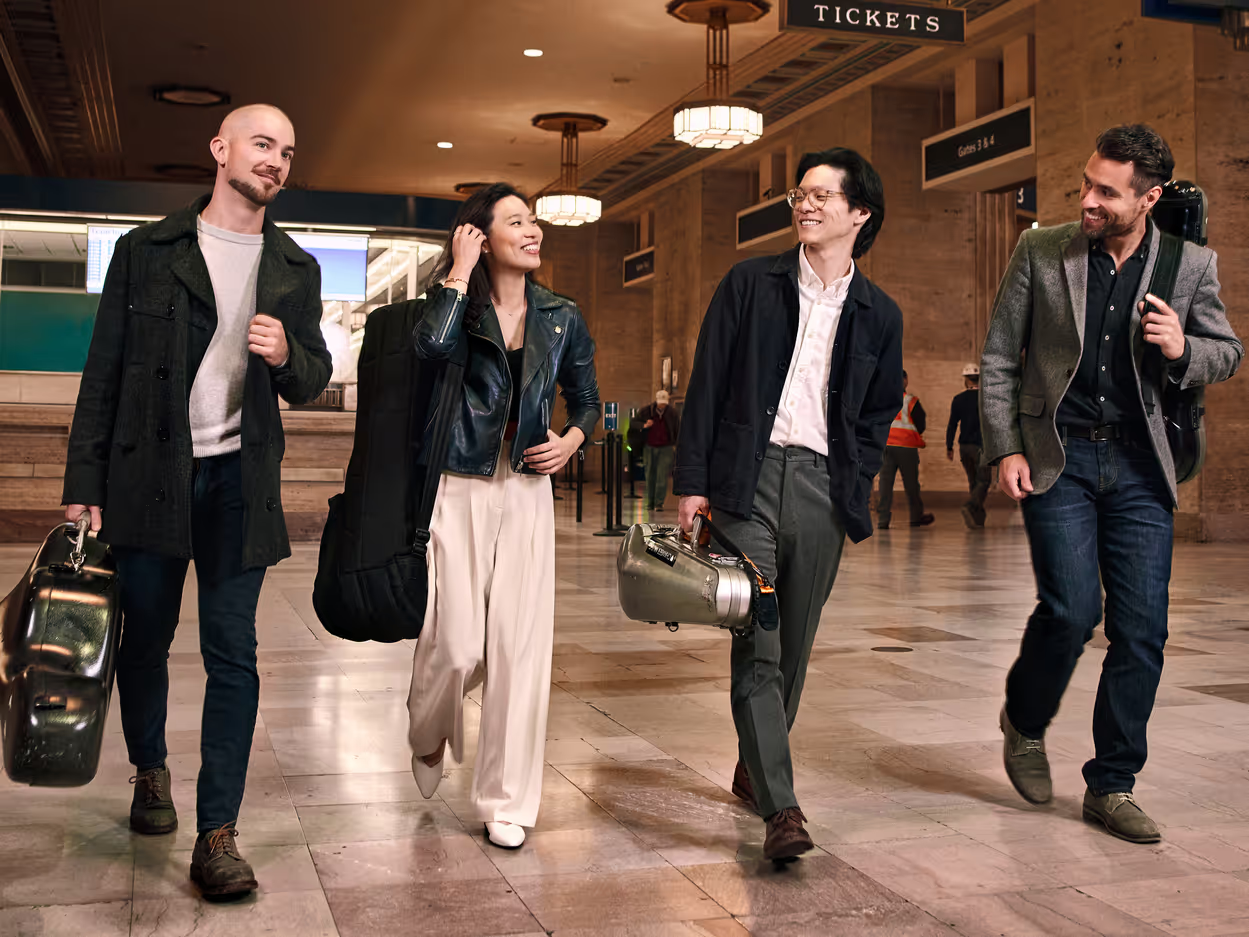
On a Wednesday evening in late October 2024, four musicians walked onto the stage of an intimate 60-seat hall in the Chicago Loop and began to play. The hall was full. Every seat sold. The quartet was Dover: Joel Link and Bryan Lee on violin, Julianne Lee on viola, and Camden Shaw on cello. The program opened with Jessie Montgomery's Strum. The series had a name nobody in the room had heard before a year earlier.
That was the beginning of Nova Linea Musica.
We had spent the months leading up to October 23 imagining what an opening concert should feel like. A new music series in Chicago is an ambitious undertaking in a city already rich with ensembles, venues, and traditions. The question was not whether we could mount a concert. The question was what kind of statement that first concert needed to make.
The answer was the Dover Quartet.
Named one of the greatest string quartets of the last 100 years by BBC Music Magazine and called "the next Guarneri Quartet" by the Chicago Tribune, Dover's stature made our intent unambiguous from the first downbeat: Nova Linea Musica was going to present new music at the level the music deserves. Not as a curiosity. Not as a discovery series for listeners unfamiliar with the form. As world-class performance, executed by artists whose careers sit at the summit of the field.
Dover programmed the evening with an arc that our audience would come to recognize as characteristic of Nova Linea Musica: living composers leading, a single pre-1950 anchor at the close.
Jessie Montgomery's Strum opened the program. Written for the Catalyst Quartet in 2012 and conceived originally for cello quintet, the piece is built around a strumming pizzicato texture that Montgomery describes as drawing "on American folk idioms and the spirit of dance and movement." The music begins in what she calls "fleeting nostalgia" and transforms "into ecstatic celebration." It was exactly the right opening. A piece that introduced itself to the room the way we hoped NLM would: confidently, warmly, unmistakably of this moment.
Mason Bates's From Amber Frozen followed. A work that grows its melodic material "at an evolutionary pace," as Bates writes, moving from rhythmic pointillism into sustained lyrical lines before dissolving back into pitchless rhythm at the work's close. The Dover Quartet navigated its architecture with the ensemble precision and interpretive clarity that has earned them Grammy nominations across three volumes of Beethoven.
The second half opened with the Molto adagio from George Walker's String Quartet No. 1, Lyric. Walker became the first Black composer to receive the Pulitzer Prize in Music in 1996 for his Lilacs for voice and orchestra. This movement, written when he was 24 years old, has become one of his most performed works. It passes a somber opening melody among the quartet in a canon-like fashion, each instrument expanding the theme, tension rising to a brief climactic moment before resolving back to the initial line. In a program of living voices, Walker's presence was a reminder of a lineage: that the new music of this moment is shaped by the composers whose work made this moment possible.
The concert closed with Antonín Dvořák's String Quartet No. 12 in F Major, the American. It was, and remains, the only pre-1950 exception in NLM's repertoire policy. We made that exception deliberately. For a series called Nova Linea Musica launching with a program called Celebration of America, Dvořák's quartet, composed in 1893 during his time directing the National Conservatory in New York, was the correct anchor. The piece has been heard as carrying African American spiritual themes, particularly in its second movement, shaped by Dvořák's relationship with the baritone and composer Harry T. Burleigh. It is one of the most beloved works in the chamber music repertoire. Dover played it not as a historical artifact but as a living inheritance.
A 60-seat hall for the Dover Quartet is an experience that even their regular audiences in Carnegie Hall, the Kennedy Center, and the great European venues rarely have. At Nova Linea Musica, the distance between the stage and the nearest listener is measured in feet, not rows. You can hear the breath, the bow finding the string, the small sounds of four musicians listening to each other.
The intimacy is not incidental. It is the point.
Each Nova Linea Musica concert includes a pre-concert discussion at 5:45 pm, the performance at 6:30, and a chef-curated reception afterward. All of it is included in a single $40 all-in ticket. On October 23, our pre-concert discussion was hosted by Doyle Armbrust, founding member of the three-time Grammy-nominated Spektral Quartet and creator of The Society of Disobedient Listeners. Dover's musicians joined the audience at the reception. Conversations happened that don't happen in larger halls.
This model, a single ticket that includes the entire evening, is part of what Nova Linea Musica set out to offer Chicago. The premise is that new music deserves to be experienced not transactionally but relationally: with preparation, with performance, and with presence afterward.
Three more concerts followed in Season 1: the NLM Artists in Residence program in January 2025, the triple world premiere of Letters from Home in March, and the season finale Chicago! in June. Every concert sold out. Four NLM commissions received their world premieres across the season, from composers including Paul Novak, Errollyn Wallen, Stacy Garrop, and Shawn E. Okpebholo.
Season 2 doubled. Eight concerts. Eight commissions. Jennifer Higdon, Third Coast Percussion, Arianna Zukerman, Black Oak Ensemble. A season that closed out as we approached our third year of programming, with a growing audience and a growing catalog of new work.
But all of that started on an October Wednesday. Four musicians. A 60-seat hall. A program that began with Montgomery's Strum and closed with Dvořák's American. A room that was full, and quiet, and listening.
Nova Linea Musica presents new music in Chicago through commissions, live performances, and exceptional audio and video recordings. Learn more about our mission and team. Explore upcoming concerts.

